
Understanding Fire Door Certification in India: IS Standards You Must Know
Introduction –
Fire safety is not just a regulatory requirement—it’s a life-saving necessity. In industrial, commercial, and residential buildings, one of the most crucial components of fire protection is the fire-rated door. These doors serve as barriers that prevent the spread of fire and smoke, ensuring people have enough time to evacuate safely.
In India, the importance of fire door certification has grown tremendously as the country moves towards stricter compliance with national and international safety standards. Manufacturers like Hercules Doors, a leading name in the industry, are setting benchmarks in producing certified, high-performance fire doors that meet or exceed Indian Standards (IS).
This article explains everything you need to know about fire door certification in India, the IS standards involved, and why choosing a certified manufacturer like Hercules Doors is vital for safety and compliance.
What Is Fire Door Certification?
Fire door certification is a formal process that verifies a door’s ability to resist fire for a specific duration—commonly 30, 60, 90, or 120 minutes. This certification ensures that the door assembly, including the frame, shutter, glazing, hardware, and seals, has been tested and approved by an accredited laboratory following the relevant Indian Standards.
Certification is essential because it proves the door’s fire resistance under real-world conditions. Only certified fire doors are legally compliant and reliable for use in hospitals, data centers, factories, hotels, educational institutions, and commercial complexes.
Why Fire Door Certification Matters
The primary role of a fire door is to contain fire and smoke, preventing them from spreading to adjacent areas. However, without proper certification, there’s no guarantee that the door will perform effectively during an emergency.
Here’s why certification matters:
Compliance with Indian building and fire codes
Protection of lives and property during fire incidents
Reduced liability for building owners and contractors
Assurance of quality and reliability
Eligibility for insurance claims and legal approvals
A certified fire door offers peace of mind that the product has undergone rigorous testing under standardized fire conditions.
Key Indian Standards for Fire Doors
India follows several important IS standards (Indian Standards) that define the construction, performance, and testing of fire-rated doors. Let’s break them down:
1. IS 3614 – Fire Check Door Assemblies
This is one of the core standards for fire doors in India.
It specifies the requirements for fire check door assemblies used in buildings to restrict the spread of fire and smoke. The standard includes guidelines for materials, construction, mounting, and testing.
2. IS 1648 – Steel Door, Shutters, and Frames
This standard covers steel doors and frames, outlining dimensions, materials, fabrication, and finishing details. It ensures the structural integrity and durability of steel fire doors used in commercial and industrial applications.
3. IS 15351 – Fire Resistant Glazing Systems
When fire doors include vision panels or glass inserts, this standard applies. It specifies the requirements for fire-resistant glass and glazing systems that can withstand high temperatures for specified durations.
4. IS 3809 – Fire Resistance of Building Materials
This standard defines the methods for testing fire resistance of building materials, including doors and walls. It helps determine how long a component can withstand exposure to fire before failing.
5. IS 4020 – Tests for Wooden Door Shutters
Although primarily for wooden doors, this standard is relevant for manufacturers producing timber-based fire doors. It includes tests for mechanical performance, resistance, and durability.
Together, these IS codes ensure that fire doors in India meet strict performance, safety, and durability benchmarks.
Understanding Fire Door Ratings
Fire doors are rated based on their ability to resist fire for a certain period. The most common ratings include:
FD30 – 30 minutes fire resistance
FD60 – 60 minutes fire resistance
FD90 – 90 minutes fire resistance
FD120 – 120 minutes fire resistance
The duration indicates how long the door can maintain its integrity and insulation under standard fire conditions. Higher ratings are used in high-risk environments like data centers, power plants, and chemical factories.
The Certification Process: Step by Step
The certification of a fire door involves multiple stages to ensure accuracy and compliance:
Step 1: Design Evaluation
The door manufacturer submits detailed designs and specifications, including materials used, thickness, reinforcement, and assembly methods.
Step 2: Sample Preparation
A prototype door assembly is built under controlled conditions according to the approved design.
Step 3: Laboratory Testing
The door undergoes fire testing in a specialized furnace. It is exposed to high temperatures following a standard time–temperature curve to measure its resistance to flames and heat.
Step 4: Performance Assessment
Inspectors evaluate how long the door remains structurally stable and prevents the passage of smoke and heat.
Step 5: Certification & Labeling
Once the door passes all tests, it receives an official certification from an accredited authority (such as CBRI, NABL, or BIS).
Certified doors are labeled with details like the fire rating, test report number, and manufacturer’s name.
Testing Parameters for Fire Doors
A certified fire door must pass several performance tests, including:
Integrity Test: Ensures no flames or hot gases pass through.
Insulation Test: Measures temperature rise on the unexposed surface.
Stability Test: Evaluates whether the door remains intact and functional.
Smoke Leakage Test: Assesses the ability to limit smoke passage.
Hardware Compatibility: Confirms the hinges, closers, and locks perform during fire exposure.
Each of these parameters contributes to a door’s final certification rating.
Common Certification Mistakes to Avoid
Many construction projects fail inspection due to non-compliance with fire door standards. Some common errors include:
Using non-certified components like hinges or intumescent seals.
Modifying a certified door after installation (e.g., drilling, trimming).
Installing the door without matching frame certification.
Lack of regular maintenance and inspection.
Always remember: even a minor deviation from certified design can invalidate the fire rating of the door.
Hercules Doors: Setting New Standards in Fire Safety
Hercules Doors is one of India’s leading manufacturers and suppliers of fire-rated steel doors, renowned for their durability, performance, and compliance with IS standards. The company has built a strong reputation across industrial, commercial, and residential projects for delivering tested and certified fire doors that ensure maximum safety.
Key Highlights of Hercules Fire Doors
Compliant with IS 3614, IS 1648, and BS 476 standards
Tested at CBRI and NABL-accredited laboratories
Available in 30, 60, 90, and 120-minute fire ratings
Designed with thermal insulation and smoke sealing technology
Manufactured using high-quality galvanised steel for strength and corrosion resistance
Custom-built sizes and finishes for diverse applications
Applications –
Hercules fire doors are widely used in:
Industrial facilities
Hospitals and laboratories
IT parks and data centers
Shopping malls and multiplexes
Hotels and educational institutions
By adhering to stringent quality standards and using advanced manufacturing technologies, Hercules Doors ensures every product stands up to real-world fire challenges.
How to Identify a Certified Fire Door
To ensure your building meets safety compliance, always check for:
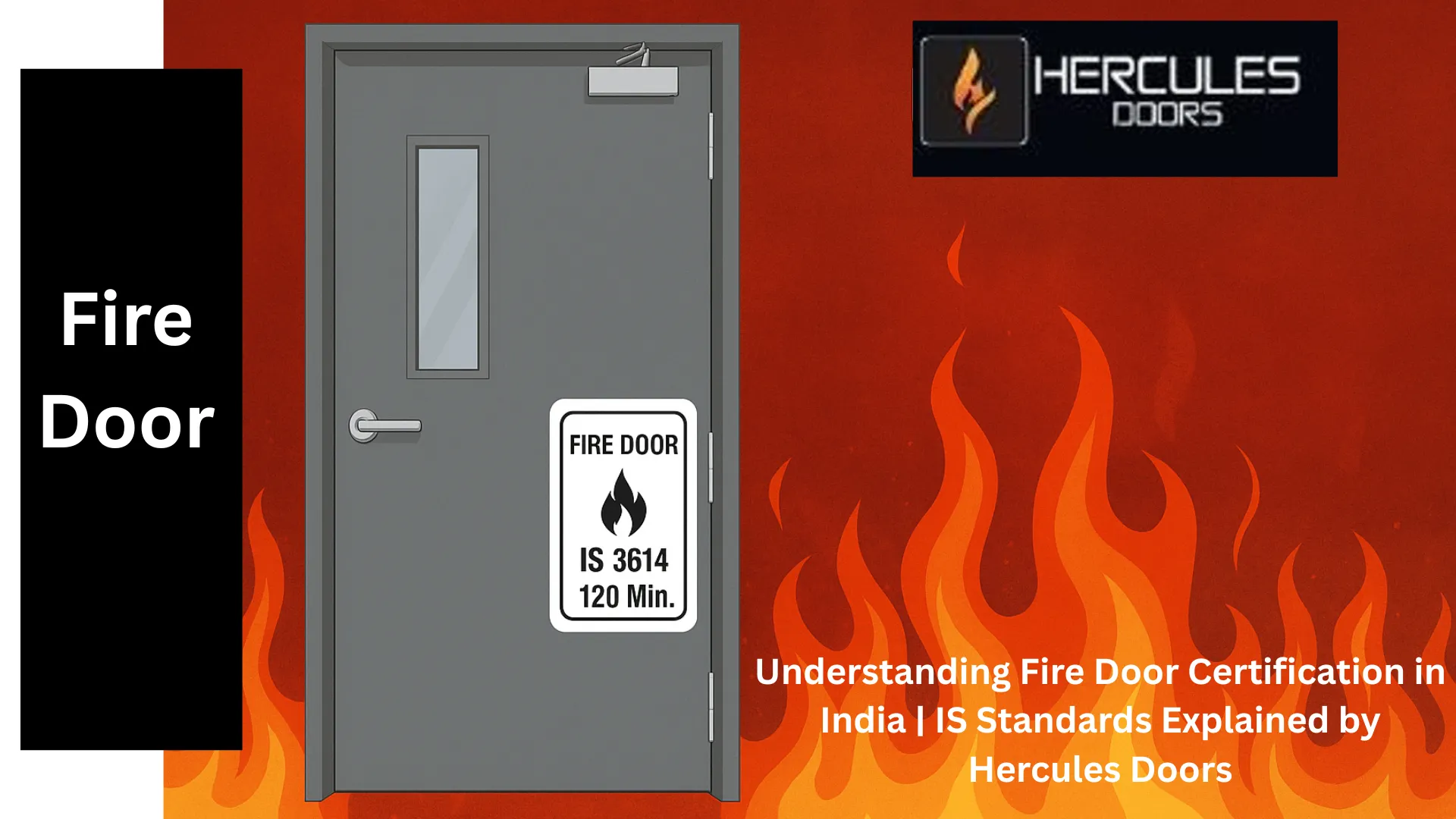
Certification label or plate on the door edge or frame
Manufacturer’s details and fire rating duration
Test report reference number from an accredited lab
Compatibility of all door components (frame, hardware, seals, etc.)
A genuine fire-rated door from Hercules Doors will always have a visible certification label, ensuring authenticity and performance.
Benefits of Choosing Certified Fire Doors from Hercules Doors
Guaranteed compliance with Indian and international fire safety standards
Enhanced life safety and property protection
Durable and low-maintenance designs
Tailored solutions for commercial, industrial, and residential projects
Trusted after-sales support and installation guidance
With Hercules Doors, clients receive not just a product, but a complete fire safety solution.
Conclusion –
Fire safety is a shared responsibility—between manufacturers, builders, architects, and facility managers. Certified fire doors form an integral part of any building’s passive fire protection system.
By understanding the IS standards and ensuring your doors are properly certified, you make your environment safer and compliant with Indian regulations.
Choosing a trusted manufacturer like Hercules Doors means you’re investing in tested, certified, and performance-guaranteed fire door systems that protect lives and assets when it matters most.